
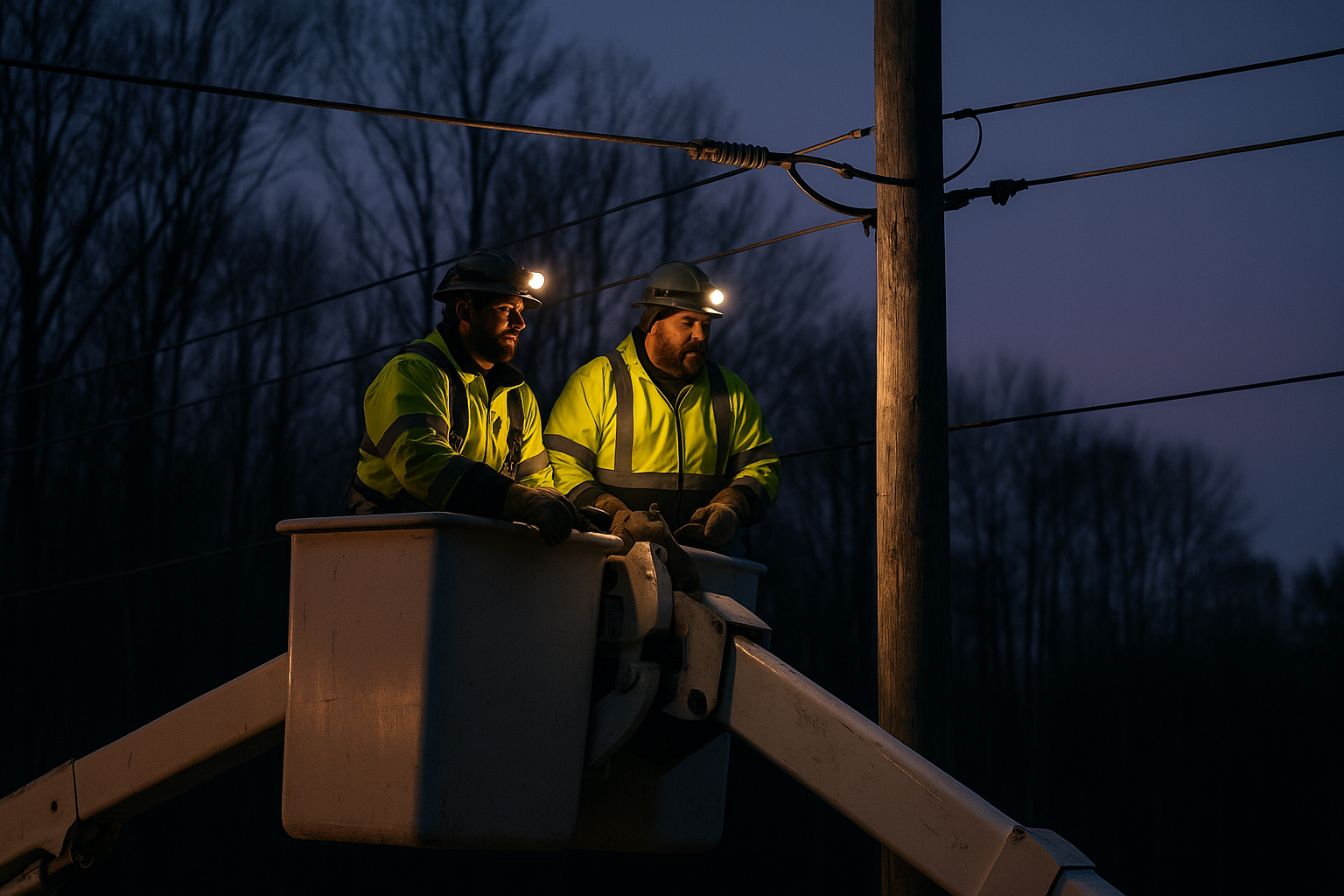
In October, as the daylight drops and the weather turns sharp, the pace on the system changes. Fall operations bring a familiar mix: planned work racing the calendar, vegetation concerns, equipment staging, and a constant eye on the forecast. Then, sometimes, the phone rings and the plan becomes restoration.
Most Canadians only see the most visible moments—tailboards at the roadside, bucket booms swinging into place, a convoy arriving in the dark. But the network isn’t held up by equipment alone. It’s held up by people: apprentices learning how to be useful under pressure, journeypersons with judgement shaped by a thousand small decisions, dispatchers and control rooms managing risk at scale, and supervisors responsible for the hardest line in the job: how fast can we do this—safely?
Fall operations: when “routine” still demands your best
Fall doesn’t always feel dramatic—but it is consequential. It’s when storm readiness becomes real: materials get counted, tools get checked, and crews tighten up the habits that make the difference when conditions go sideways. In culture terms, this season is where pride in the trade shows up in the details: the clean truck, the quiet competence, the standard you keep even when no one’s watching.
Public expectations are also different in fall. With severe weather more likely, customers watch outage maps closely, and social media can turn into a live commentary on restoration. That’s where the human part of linework becomes visible: not just the ability to build and repair, but the ability to remain professional in a public-facing, time-critical environment.
What the public doesn’t see: restoration priorities and the “safety-first” reality
There’s a common misconception that restoration is simply “first come, first served.” In reality, utilities prioritize public hazards and system-level work that restores the most customers safely and efficiently.
BC Hydro is explicit about one foundational principle: crews attend outages with downed lines or other immediate public risks first, and crews may be reassigned mid-task when a higher-risk situation emerges. That can be frustrating for customers watching a status update—but it reflects the reality that restoration is dynamic and risk-driven, not linear. (www.bchydro.com)
Hydro One’s public messaging reinforces the safety focus from the other side of the fence: if you encounter a downed line, stay at least 10 metres back and report it. Utilities repeat this because lines can remain energized and the ground around them may be electrified. (www.hydroone.com)
Inside the trade, that public advice connects to a deeper truth: storm work is never just technical. It’s hazard recognition, scene control, switching coordination, traffic risk, fatigue management, and the discipline to avoid the “one more thing” mindset when conditions are changing. Good lineworkers are fast—but they’re fast because they’re methodical.
Mutual assistance: pride, professionalism, and the ability to work like one crew
In storm season, Canadian linework culture expands beyond any single utility or contractor. Mutual assistance is the mechanism that turns “local response” into “regional muscle.” When an event overwhelms one service territory, others send people and equipment to help restore service—under agreed processes and governance.
In Ontario, Electricity Canada describes the Ontario Mutual Assistance Program (OnMAG) as a single point of contact for members to request and offer resources during damaging events. The program is member-led and structured to support coordination, including training/exercises and regular meetings to share restoration lessons learned. (www.electricity.ca)
At the national level, Electricity Canada has also described efforts to update and strengthen the Canadian Mutual Assistance Agreement as a membership model, aiming for a more streamlined response during crises and broader resource sharing beyond provincial boundaries. (www.electricity.ca)
That mutual-aid mindset is not new. Electricity Canada has previously reported on a national mutual assistance agreement signed by Canadian utilities in 2015, reflecting a recognized need for multilateral support during major events. (www.electricity.ca)
For lineworkers, mutual assistance has a culture of its own. You roll into a different territory, on unfamiliar streets, into a system you don’t own—but the expectations are the same: follow local rules, respect local leadership, do the job right, and go home safe. Pride in the trade becomes portable. It’s what you bring with you.
The “Faces of the Industry” idea—and why it matters to the trade
The powerline world can be quick to praise toughness and long hours. But one of the healthiest cultural shifts in the last decade has been a more explicit respect for coordination, planning, and leadership that makes tough work safer and more effective.
Electricity Canada’s “Faces of the Industry” recognition has highlighted that kind of leadership—pointing, for example, to work connected with modernizing mutual assistance approaches in Ontario and beyond. Whether you’re a superintendent, a foreperson, or an apprentice trying to learn how to move at storm pace, the message is consistent: the people behind the network include the builders and the organizers. (www.electricity.ca)
Apprentices in fall operations: earning trust, not just hours
Fall operations are a proving ground for apprentices. The work can shift from steady production to urgent restoration, and a new apprentice learns quickly that “being around” isn’t the same as being useful. The most respected apprentices tend to share a few habits:
- They anticipate the next step (without freelancing beyond their role).
- They protect the crew’s pace by staging, checking, and keeping the work area tight.
- They ask questions at the right time—and listen like their life depends on it.
- They treat storm work like professional work, not adrenaline work.
Canada’s labour market signals also underline why apprentices matter. The federal Job Bank outlook for “Apprentice lineman/woman – electric power systems” (2024–2033) presents a national “balanced” outlook and reports 2023 employment for the occupation, alongside demographics like median retirement age. The point isn’t the exact numbers—it’s the reality that the workforce is an ongoing pipeline, and every apprentice who sticks and progresses is part of keeping the industry resilient. (www.nl.jobbank.gc.ca)
Electricity Human Resources Canada (EHRC) continues to frame workforce as a sector-wide issue—tracking themes like recruitment, retention, training, and emerging skill needs through labour market intelligence work. That’s not just “HR talk.” It’s the backdrop to the daily operational reality: you can’t restore with crews you don’t have. (ehrc.ca)
Pride in the trade: what it actually looks like in 2026
Ask a lineworker what they’re proud of and the answers rarely sound like a slogan. Pride usually comes out practical:
- The customer moments: a crew restoring a feeder and watching a whole block light up—knowing someone’s heat or well pump just came back.
- The crew moments: a foreperson who makes the call to slow down, re-brief, or re-check, even when everyone’s tired.
- The craft moments: the clean build, the solid rigging plan, the switching that goes exactly the way it’s supposed to.
- The mutual aid moments: showing up for another territory because you know they’d do the same for you.
There’s also a quieter pride in the standards that don’t change when the pressure climbs. Utilities consistently tell the public to keep clear of downed lines because those hazards don’t care about intention or urgency. Inside the trade, that same principle applies to every step: the job must be done in alignment with employer procedures, utility requirements, and jurisdictional rules. Public appreciation is meaningful—but it can’t be the reason you take shortcuts.
Culture, not heroics: the future of storm readiness
Storm readiness will always have a dramatic edge because the stakes are real. But the best crews don’t chase drama. They chase competence: preparation, coordination, and disciplined execution.
If there’s one cultural thread that ties fall operations, workforce development, and storm response together, it’s this: linework is a team trade. The “people behind the network” include the ones in the air and on the hooks, the ones in the control centre, the planners, the trainers, the yard staff, and the mutual-assistance partners ready to roll. When the weather hits and the lights go out, Canada’s restoration story is, at its core, a human story.