
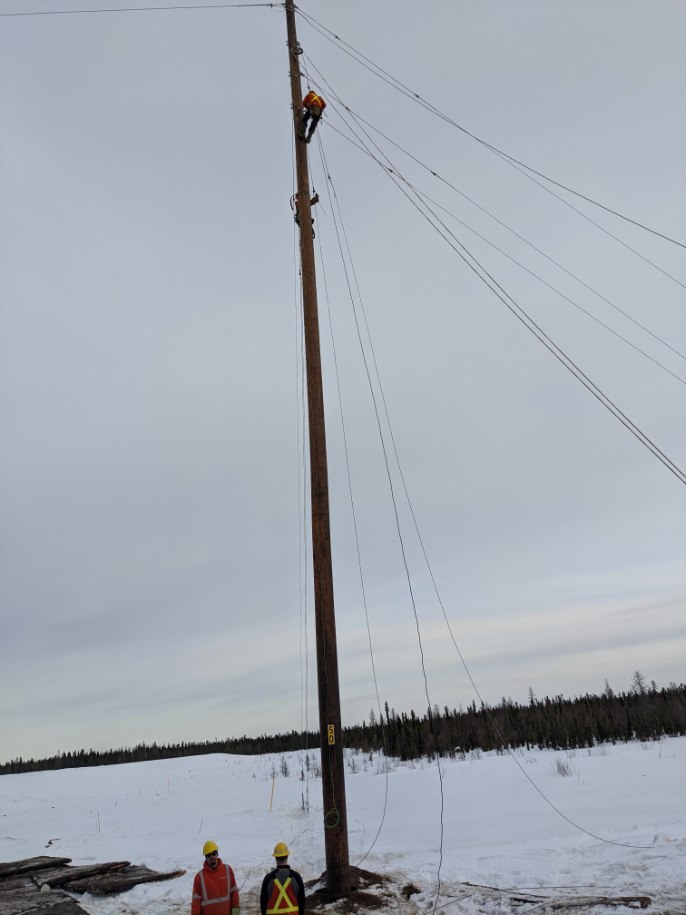
Reliability is often talked about as a metric. For line crews, it’s more concrete: a feeder that stays up during a wet snow event, a substation that keeps operating after flooding, a transmission structure that rides out extreme winds, and a system that can be assessed, isolated and restored without rushing decisions that put people in harm’s way.
Across Canada, the “work behind a reliable grid” is shifting from a steady diet of sustainment into a period where sustainment, growth and resilience upgrades are landing at the same time. Federal energy analysis projects electricity generation growth in every scenario through 2050—meaning more assets and more maintenance—and it also anticipates very large cumulative capital and repair expenditures in the electricity sector over the next decades. (www.cer-rec.gc.ca)
That macro trend shows up locally as fall operations calendars that fill fast: pole programs, reconductoring, station retrofits, corridor clearing, relay and control upgrades, and a long list of “small” distribution projects that collectively move the reliability needle. Storm season doesn’t wait for project schedules to clear—so the industry has to build and harden while also staying ready to respond.
Why reliability work is accelerating
Three forces are converging.
- Rising demand and new load patterns. Ontario’s IESO has flagged demand growth drivers including large step loads such as electric arc furnaces, EV battery manufacturing facilities and data centres—loads that can change where constraints show up and when system peaks occur. (www.ieso.ca)
- Electrification and long-run growth expectations. The Canada Energy Regulator’s 2026 outlook projects electricity demand rising materially across scenarios through 2050, reflecting economic growth and electrification of end uses. (www.cer-rec.gc.ca)
- Weather and climate stressors. Research organizations and reliability bodies have been explicit that severe weather is a growing driver of outages and that utilities are putting more emphasis on resiliency and restoration strategies—not just stronger designs. (transmission.epri.com)
For the trades, this means growth work and reliability work can no longer be separated cleanly. A new industrial load may require a substation expansion and a feeder rebuild. A transmission reinforcement project may be justified by both growth and contingency performance. A vegetation program can be both day-to-day reliability and major storm resilience.
Transmission: interties, reinforcement and restoration planning
Transmission is the backbone for moving energy from where it’s generated to where it’s needed—and for supporting interprovincial transfers that can help balance variable supply and demand. Nationally, the CER highlights that interprovincial trade enabled by transmission interties is expected to play a growing role in balancing variations in electricity supply and demand across provincial systems. (neb-one.gc.ca)
In Atlantic Canada, the federal government announced funding in July 2026 to advance the Prince Edward Island–New Brunswick Interconnection Expansion Project through engineering, surveys, environmental assessments, engagement and preliminary design, with a construction runway referenced for 2028. The announcement also describes the technical concept: two new 200 MW, 138 kV submarine cables plus transmission upgrades and substation modernization in both provinces—explicitly framed as a regional reliability improvement. (Government of Canada)
In Ontario, the IESO’s Reliability Outlook (January 2026–June 2027) references Phase 1 of the Waasigan Transmission Project with a completion target of Q4 2026 for a new double-circuit 230 kV line between Lakehead TS and Mackenzie TS. Projects like this matter to field work not only because they are large builds, but because they drive schedules for outage windows, switching coordination, material delivery, and commissioning resources at the same time crews are supporting storm response readiness. (www.ieso.ca)
Québec is also planning major transmission evolution. Hydro-Québec describes a plan to add new substations and high-voltage lines in key areas, with a public-facing description that includes roughly 850 km of high-voltage lines and five strategic substations as part of strengthening its main transmission system. (www.hydroquebec.com)
From the reliability-and-restoration lens, the build is only part of the story. Severe-weather resiliency work increasingly includes how the system is assessed after damage, how quickly conditions can be made safe for restoration, and how temporary or emergency structures are designed and deployed. EPRI’s transmission resiliency work emphasizes both hardening and the ability to rapidly assess damage and restore service—two halves of resilience that show up directly in fall preparation: patrol methods, access planning, staging, and restoration engineering support. (transmission.epri.com)
Distribution: the “last mile” where most outages are felt
Transmission headlines are big, but the public experiences reliability mostly through distribution: laterals, devices, underground networks, service drops, and the pole line running through the right-of-way behind a subdivision. Ontario’s government explicitly describes distribution as the “last step” that needs to grow and evolve in an electrifying province. (www.ontario.ca)
Distribution modernization is also where projects and storm readiness collide most often. A feeder rebuild might be scheduled as a capital project, then gets interrupted by a windstorm that drops trees across the same circuit. Or a device automation upgrade becomes the difference between an all-night patrol and a more targeted response.
Utilities are documenting the increasing operational impacts of storms and wildfires. BC Hydro reported more than 600,000 storm-related customer interruptions in 2025 (with outages primarily attributed to atmospheric river events in mid-December affecting the Lower Mainland and Vancouver Island), and it also described wildfire-driven outages and asset replacement (including transmission structures and distribution poles). (www.bchydro.com)
Those impacts translate into infrastructure decisions that field workers see first: pole replacements and class upgrades, crossarm and hardware changes, selective undergrounding where it makes sense, device placement and coordination, and targeted rebuilds in high-exposure corridors. Just as important, they drive investments in preparedness: weather forecasting, logistics, and mutual assistance coordination. (www.bchydro.com)
Vegetation management: reliability work that becomes resilience work
Ask a crew what causes the most grief during storm season and you’ll hear some familiar answers: saturated ground, access issues, and trees. EPRI’s work on distribution grid resiliency notes that utilities’ vegetation management for day-to-day reliability and major storm resilience often differs “only in degree,” and it points to common approaches such as enhanced tree trimming and hazard tree removal. (restservice.epri.com)
BC Hydro provides a concrete example of scale: it states that in FY 2026 it invested more than $160 million in vegetation management, linking this spend to both storm preparation and wildfire mitigation. (www.bchydro.com)
For employers and supervisors, vegetation programs are not just “tree work.” They’re multi-crew coordination problems with public risk, contractor management, roadway controls, and in some cases energized proximity considerations. They also shape fall operations planning: crew availability, outage planning, and the reliability tradeoffs of taking circuits out of service for proactive work versus holding capacity for storm response.
Substations, protection and controls: reliability is increasingly engineered
Reliability isn’t only about stronger wood and more steel. It’s also about modern controls, protection schemes, communications, and station equipment that can isolate faults correctly and recover quickly.
Hydro-Québec’s 2025 annual report describes major investments in sustaining and developing assets and references modernization such as replacement of grid control systems, special protection systems, and substation protections and controls—work that is less visible to the public, but foundational to keeping outages smaller and restorations safer. (www.hydroquebec.com)
For lineworkers, this is where traditional boundaries blur: protection settings influence how a line behaves during a fault, automation affects the number of spans that must be patrolled, and station work timing influences when circuits can be safely returned to normal configuration. Crews still build and repair, but they do it inside systems that are increasingly “instrumented.”
Mutual assistance and logistics: the infrastructure behind the infrastructure
Storm readiness is partly about poles, wire and devices—but it is also about the support systems that keep crews fed, housed, transported and supplied in prolonged events.
In Canada, Electricity Canada (formerly CEA) announced in 2015 that Canadian utilities signed a National Mutual Assistance Agreement—an industry-level framework for support during emergency outages. (www.electricity.ca)
Provincially, mutual assistance programs continue to formalize how requests and offers are coordinated. Electricity Canada describes Ontario’s Mutual Assistance Program (OnMAG) as a single point of contact to request and offer assistance resources during damaging events, including governance considerations under Ontario provincial laws. (www.electricity.ca)
For field leaders, mutual assistance readiness shows up in the practical details: credentialing, orientation, mapping and circuit information, compatible material standards, and clear lines of authority. For travelling crews, it’s the difference between arriving and being productive quickly—or losing time to avoidable friction.
Workforce reality: fall operations under a “do both” mandate
Fall has always been a heavy work season. The difference now is that reliability is being asked to do more things at once:
- Sustain an aging asset base while integrating new technology and new customer demands.
- Build new infrastructure (new stations, new lines, reinforcements, interties) while keeping outages minimized.
- Harden and adapt to storm and wildfire impacts while responding to those same events in real time.
Utilities’ own reporting reflects the scale of investment required. Hydro-Québec, for example, reported $6.9 billion invested in property, plant and equipment and intangible assets in 2025 (up from $6.0 billion in 2024), describing this as aligned with priorities to provide reliable, high-quality service through sustained investment in generating, transmission and distribution facilities. (www.hydroquebec.com)
At the national level, the CER’s 2026 analysis projects that growing Canada’s electricity supply requires considerable investment, with long-run cumulative capital and repair expenditures measured in the hundreds of billions to over a trillion (2025 dollars) across scenarios from 2025 to 2050. (www.cer-rec.gc.ca)
None of that investment happens without people: apprentices coming in, journeypersons training them, and employers building schedules that protect fatigue management and competency development even when storm calls and major projects compete for the same crews.
What “reliability investment” means for the jobsite
For PLT readers, it can help to translate grid investment talk into jobsite realities. This fall, reliability work is likely to look like:
- More corridor work with tighter planning windows: vegetation cycles, access improvements, and pre-staging for restoration routes.
- Targeted hardening: replacing poor-performing components, pole upgrades in high-exposure areas, and selective rebuilds rather than blanket replacement.
- More commissioning interfaces: protection-and-control coordination, station expansions, and “one change affects many” switching plans.
- More joint work planning: with telecom, municipalities, road authorities, forestry partners, and Indigenous communities—because the route, the access, and the engagement plan increasingly drive schedule and cost.
- More formalized storm logistics: mutual assistance, staging yards, supply chain resilience, and clear restoration priorities.
None of these are substitutes for utility procedures or jurisdictional rules, and every system has its own operating reality. But the direction is consistent: reliable service is being built as much through planning, coordination and modernization as through raw construction volume.
Reliability still starts with doing the basics well
As the grid evolves, there’s a temptation to treat reliability as something advanced: analytics, automation, and resilience frameworks. Those matter. But reliability is still deeply physical and deeply human: good structure framing, correct tensions, clean grounds, tight hardware, accurate as-builts, disciplined switching, and crews who can communicate under pressure when weather is turning.
This fall, Canada’s grid reliability story won’t be written only in boardrooms, rate applications or federal announcements. It will be written in the right-of-way, on the line, in the station, and in the storm—by the people who build it and restore it.