
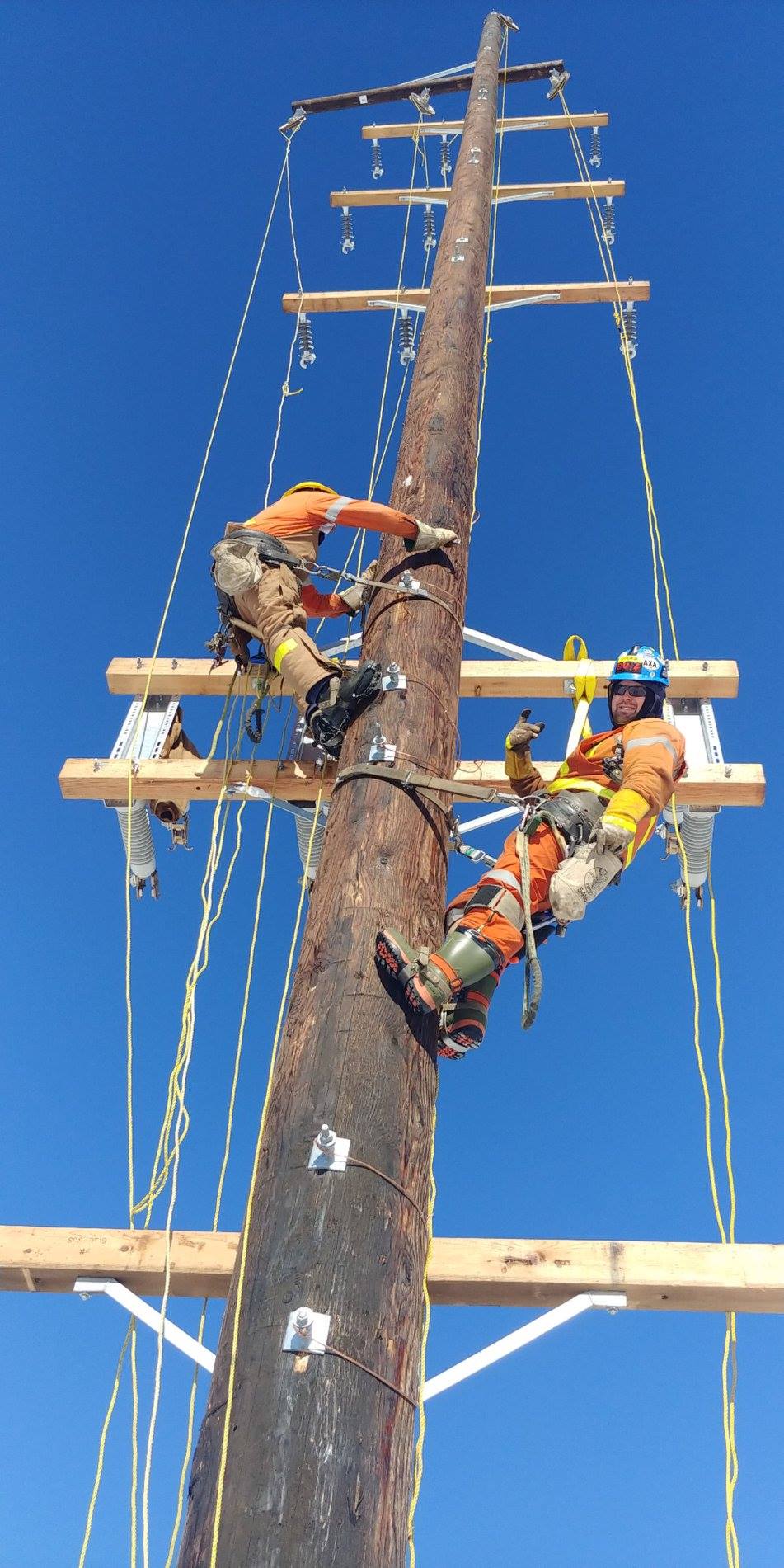
Every fall, storm readiness puts training under a microscope. Long nights, cold hands, unfamiliar circuits, mutual-aid crews, and tight restoration windows expose a simple truth: training isn’t “credible” because it was delivered; it’s credible because it shows up in the field—under pressure—without crews improvising fundamentals.
In the powerline world, “training that transfers” is not a soft concept. It’s measurable. It’s the difference between a worker who can repeat steps in a classroom and a worker who can plan, communicate, recognize hazards, and execute within the employer’s rules and the job’s constraints. And it’s the difference between an employer who can point to attendance sheets and an employer who can demonstrate competency, supervision, and continuous reinforcement of the organization’s work practices.
1) Start with a hard line: standards and law point back to the employer
Field transfer begins with a clarity that sometimes gets lost in course marketing: even the best external training is only one input. In workplace electrical safety, CSA Z462 explicitly places responsibility on the employer to establish and implement safety-related work practices and to provide workers with training in those practices and procedures. That framing matters because it makes “transfer” an organizational obligation, not just an instructor’s goal.
For federally regulated workplaces, the Government of Canada’s guidance on employer and employee duties similarly emphasizes employer responsibilities around providing workers access to regulations and ensuring training where necessary. The specific requirements for electrical utility and construction work will still be provincial/territorial in many cases, but the principle is consistent: the employer owns the system that turns training into safe performance.
2) Credible training maps to the trade—then maps again to the job
In Canada, powerline training has an advantage: the trade is defined. The Red Seal program identifies Powerline Technician as the trade name and describes a harmonized structure that totals 7,200 hours of on-the-job and in-school training. For transfer, that’s a built-in compass: if a course can’t clearly point to the tasks and sub-tasks it supports, it’s harder to defend as “job-ready.”
The Red Seal Occupational Standard (RSOS) for Powerline Technician goes further by laying out a task matrix where a major portion of the trade relates to safety-related functions, hazard control, lockout/tagout, temporary grounding and bonding, work planning, worksite access, and live-line methods. This is a practical message for trainers: credibility is not only about teaching how to build—it's about teaching how to work safely, consistently, and communicatively in the environments where building happens.
But mapping to the trade is only step one. Storm readiness demands step two: mapping to your work. Distribution vs. transmission, underground vs. overhead, utility vs. contractor, and jurisdiction-specific switching/protection rules change what “good” looks like. The most transferable programs are explicit about what’s common-core and what is employer- or utility-specific—and they create structured handoffs so the employer can complete the job-specific portion.
3) Scenario practice beats “topic coverage” when the weather turns
Fall operations don’t fail because a worker forgot a definition. They fail when multiple risks stack up: fatigue, traffic exposure, cold, poor visibility, damaged infrastructure, urgent service restoration, and competing priorities. Training transfers when it intentionally reproduces that complexity in a controlled way.
Ontario provides a clear example of how scenario-based learning fits utility work. IHSA describes the Utility Work Protection Code (UWPC) as a system that reduces or eliminates hazards by making isolation and safe conditions clear through permits and tags. IHSA’s UWPC training is structured around detailed study and scenario work for those who issue permits and those who work under them, with recertification noted as a requirement. The credibility signal here is not the length of the course; it’s the deliberate practice of applying rules to situations, not just reading rules.
Even for workers who don’t need full code qualification, IHSA’s UWPC Overview concept points toward a transfer principle: tailor training to the decisions workers must make in the field. If the course content is mismatched to the actual responsibilities of the work group, pass/fail becomes a poor proxy for readiness.
4) Rescue is the litmus test: if you train at heights, you train the “what if”
Credible training is ruthless about the uncomfortable parts of the job. Rescue is one of them—because storms don’t schedule injuries, and suspension time is not a theoretical concern.
Provincial requirements vary, but regulators are clear that rescue planning belongs inside fall protection planning. Alberta’s OHS Code (Fall Protection) requires an employer to develop a fall protection plan in certain circumstances and that plan must specify rescue procedures if a worker falls and is suspended and needs to be rescued. The Code also requires workers be trained before being allowed to work where fall protection must be used, including emergency response procedures and practice of those procedures.
WorkSafeBC’s guidance on fall protection plans similarly expects written plans to specify rescue procedures for a suspended worker who cannot self-rescue, and highlights that rescue/evacuation considerations may still apply even when a formal fall protection plan is not required for the situation.
At the trade training level, the Nova Scotia Powerline Technician Apprenticeship Curriculum Standard includes detailed rescue competencies (pole top rescue using a bucket, tower rescue methods, bucket evacuation, and bucket rescue), reinforcing that rescue is a core capability that must be taught and practiced—not an afterthought.
The transfer takeaway: if your fall operations ramp up in October, and your training package can’t clearly show how rescue procedures are taught, practiced, evaluated, and refreshed, you have a credibility gap—no matter how impressive the equipment list looks.
5) Small classes and experienced instructors help—but only if the program proves competence
Workers will often describe “credible” training in human terms: instructors who have done the work, time for coaching, and a training yard that looks like the field. Those factors matter because they enable repetition, feedback, and correction before habits calcify.
IHSA’s profile of its powerline technician apprenticeship training describes small class sizes, an outdoor training yard with a variety of infrastructure and equipment, and instructors with significant industry experience. Those design choices support transfer because they increase hands-on time and allow instructors to teach not just steps, but reasons and consequences.
However, credibility can’t rest on reputation alone. For employers and training organizations, the question is: can you produce evidence of competency, not just participation? The best programs build assessment into performance: observed tasks, documented checklists, coaching notes, and clear thresholds for “ready for supervised field work” versus “ready for independent work.” That evidence becomes essential in storm season when staffing is tight and supervisors must make fast decisions about who can safely do what.
6) Work-integrated learning: the fastest path from “trained” to “effective”
Electricity sector workforce groups have been explicit that classroom learning needs structured pathways into real work. Electricity Human Resources Canada (EHRC) has emphasized work-integrated learning (WIL) as a key transition step from school to work—because it connects education to practice and helps prepare the next generation of electricity workers.
For storm readiness, WIL isn’t just a youth or recruitment topic. It’s an operating model: controlled exposure to real tasks with real standards, coached by competent mentors, and supported by a learning plan. It’s also a retention model, because workers gain confidence when the handoff from school to crew is designed rather than improvised.
7) A practical “transfer checklist” for fall storm readiness (without replacing your procedures)
Training leaders and operations managers don’t need more slogans—they need a way to audit training credibility quickly before the weather forces the issue. The following checklist is designed to be adapted to your employer/utility procedures, jurisdictional requirements, and manufacturer instructions.
Transfer Checklist: What to verify before crews go back to operations
- Task alignment: Each module clearly maps to Red Seal RSOS tasks (or equivalent internal task standards) and to the specific work the crew will perform (distribution, transmission, underground, stations, etc.).
- Decision practice: Workers practice decision points under scenario pressure (job planning, hazard identification, controls, communication, stop-work triggers).
- Work protection literacy: Where applicable, workers understand how your switching/protection/work permit system functions, their responsibilities under it, and how to recognize when conditions are not as expected (for Ontario, UWPC-related role clarity is a strong example of this approach).
- Rescue readiness: Rescue procedures are job- and site-relevant, practiced hands-on, and reviewed as part of fall protection planning (consistent with expectations reflected in Alberta and BC regulatory guidance).
- Assessment evidence: You can show documented performance evaluations, not just course completion. Any gaps have a remediation plan.
- Field reinforcement plan: Supervisors and journeyperson mentors know what was taught, what was assessed, and what must be reinforced during the first shifts back.
- Refresher/recertification rhythm: Time-based and risk-based refreshers are scheduled (for example, some programs note recertification cycles such as every three years for specific code training), and storm-season pre-job refreshers are built into mobilization.
8) The credibility test: can a crew do it right on a bad day?
Storm readiness is the harshest validator of training transfer because it forces real work under imperfect conditions. When training is credible, crews return to operations with shared language, consistent hazard controls, and practiced responses—especially around work protection, work-at-height, and rescue. When it isn’t, supervisors end up re-teaching basics on the tailboard while outages and risks pile up.
The strongest training programs don’t promise to replace employer procedures—they are designed to connect to them. They align to recognized occupational standards, integrate scenario work, require performance-based assessment, and set up a deliberate handoff into coached field practice. In fall operations, that’s what makes training not just defensible, but dependable.