
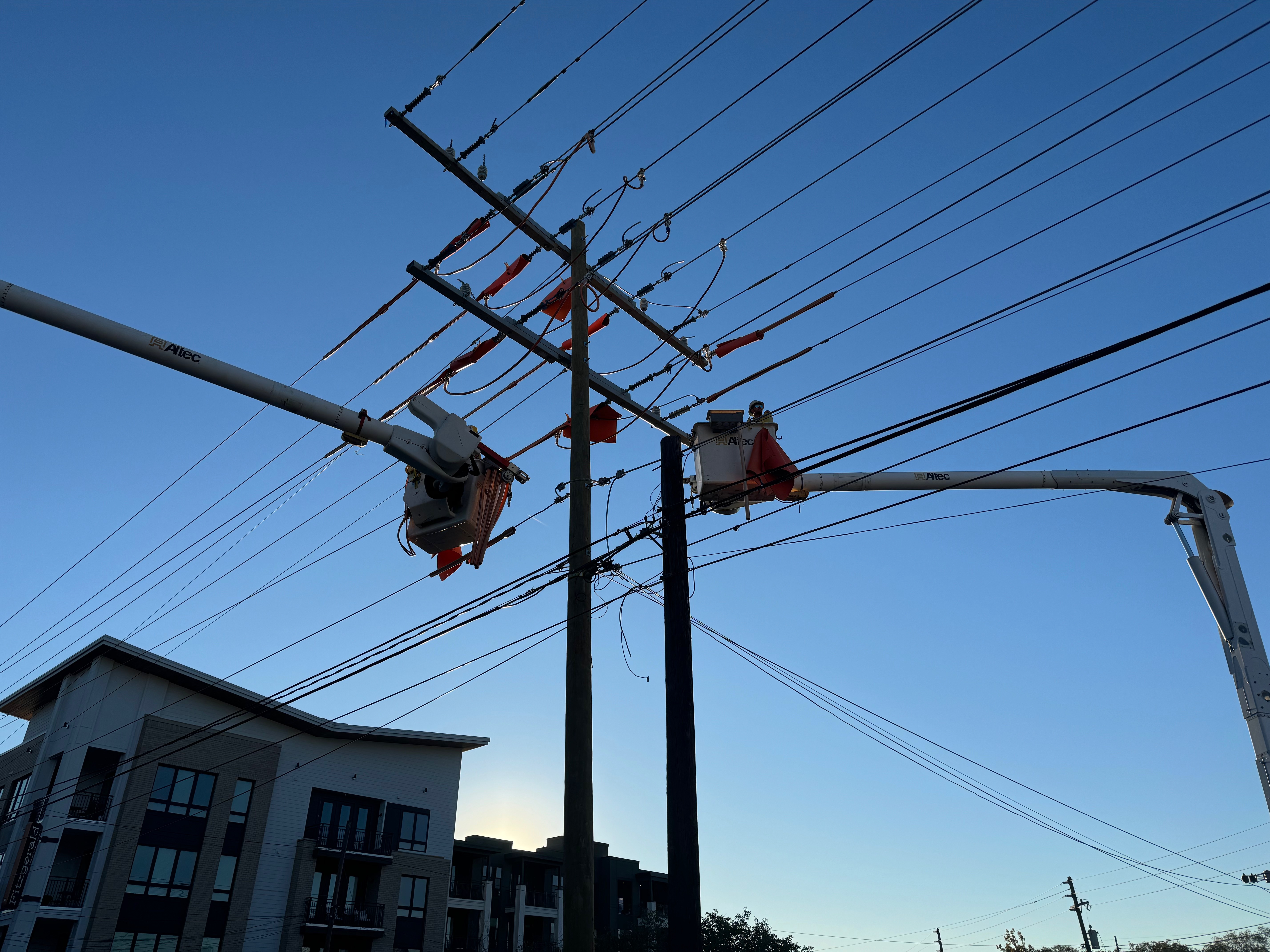
Across Canada, the powerline workforce is facing a pressure pattern that line crews can feel long before it shows up in a spreadsheet: storm response is more frequent and logistically heavier, major utilities and contractors are competing for the same experienced hands, and apprenticeship systems are being asked to deliver more throughput without diluting competence. The result is a familiar paradox: in some regions there may be enough people in the occupation on paper, yet dispatch and supervisors still struggle to field the right mix of qualified, current, and storm-ready workers on short notice.
This article is about where the pressure is building—demand, mobility, qualifications, and experience—and what that means for lineworkers, apprentices, employers, and trainers heading into fall operations.
Demand: the national picture can look “balanced” while local reality stays tight
At the national level, Employment and Social Development Canada’s Canadian Occupational Projection System (COPS) forecasts that, for Electrical power line and cable workers (NOC 72203), job openings and job seekers may be roughly similar over the 2024–2033 period (3,200 openings and 3,200 seekers). (Employment and Social Development Canada) That’s an important anchor: it suggests the occupation isn’t universally facing an unlimited shortfall everywhere, every year.
But Job Bank outlooks—which are presented by region and updated with recent trend data—still show “Good” prospects in some high-demand areas (for example, Ontario’s 2025–2027 outlook). (Government of Canada Job Bank) For employers and crews, that combination (balanced long-term, tight short-term, uneven by region) is the recipe for volatility: hiring pressure spikes around storm seasons, large capital programs, and planned outages, and then relaxes—until the next event.
Two things make “average” conditions misleading for linework:
- Experience matters disproportionately. Not every worker in the occupation can step into storm restoration leadership, complex switching support, or high-risk distribution and transmission tasks with the same readiness.
- Mobility is constrained by more than a ticket. Travel time, family commitments, rotational fatigue, employer policies, and differing utility work methods all affect whether mutual aid is actually available when the system needs it.
Storm response is a workforce issue, not just an emergency-management issue
Utilities have always depended on surge capacity during major outages. What’s changing is how consistently that surge capacity is being used—and how much planning is required to bring outside crews in safely and efficiently. Electricity Canada’s emergency-management material captures the scale of logistics during large events, including feeding and housing mutual assistance personnel and coordinating fuel and staging. (www.electricity.ca)
In Ontario, Electricity Canada’s Ontario Mutual Assistance Program (OnMAG) formalizes a single point of contact for utilities to request and offer resources during damaging events, and it positions mutual assistance as an ongoing program—complete with meetings to share lessons learned and restoration experience. (www.electricity.ca)
For the workforce, that matters because mutual assistance is no longer an occasional favour—it’s becoming part of the operating model. That increases the value of workers who are:
- current on required training and fit-for-duty expectations;
- comfortable in unfamiliar systems and local work methods;
- able to lead safely under fatigue and time pressure; and
- effective at documentation, switching coordination, and communications under incident command structures.
In other words, storm readiness is directly tied to workforce development and retention, not just storm plans and fleet readiness.
Qualifications: Red Seal supports mobility, but it isn’t the whole story
For powerline technicians, Canada’s interprovincial framework is a strength. The Red Seal program sets a national occupational standard for the trade, with the Red Seal Occupational Standard (RSOS) recognized by the Canadian Council of Directors of Apprenticeship (CCDA). (www.red-seal.ca) The Red Seal program also supports harmonization efforts intended to facilitate mobility across participating jurisdictions, even though each province and territory remains responsible for its own apprenticeship program. (red-seal.ca)
At the occupation level, the federal NOC profile reflects the typical pathway: completion of a provincial apprenticeship (often three to four years) or equivalent experience/training, with Red Seal endorsement available to qualified workers who pass the interprovincial exam. (noc.esdc.gc.ca)
So why does mobility still feel hard in practice?
- Utility-specific qualification still rules the day. Even when a worker is fully ticketed, host utilities and contractors often require additional sign-offs, orientation, and local method verification before someone is considered competent for certain tasks on that system.
- Storm work compresses onboarding time. During an event, there’s less margin for “learning the local way,” which raises the bar for what “ready to travel” really means.
- Supervision capacity becomes the limiting factor. When experienced forepersons are thin, adding more outside crews can overload switching coordinators, safety oversight, and job planning functions.
Experience: the real scarcity is the middle and top of the bench
Canada can produce apprentices. The harder problem is building enough experienced journeypersons and supervisors who can carry complex work and mentor effectively—especially when travel and overtime are already elevated.
That pressure shows up in predictable places:
- Foreperson coverage for multi-crew restoration, especially when jobs are dispersed and conditions are deteriorating.
- Switching and isolation planning support for restoration in urban networks or heavily sectionalized rural feeders.
- Training capacity in the field, where journeypersons are asked to both produce and teach—often at the same time.
When the experienced bench is thin, organizations tend to compensate with overtime. That can work in the short term, but it carries a known cost: fatigue risk, increased supervision burden, and slower progression for apprentices when coaching time disappears.
Safety and competence: “qualified” must remain specific and defensible
As mobility and mutual assistance expand, there’s a parallel need for consistency in how employers define and verify competence. Industry safety standards and employer programs differ by jurisdiction and utility, but the trend is consistent: employers are expected to maintain structured electrical safety programs and ensure workers are competent for the tasks they perform.
CSA Z462 (Workplace electrical safety) is one widely referenced Canadian standard for electrical safety management systems, safe work practices, and PPE selection for persons exposed to electrical hazards. (webstore.ansi.org) CSA’s public review system also indicates ongoing updates to Z462 (with a draft labeled CSA Z462:27 having a public review window in 2026), a reminder that training content and program alignment need periodic refresh. (publicreview.csa.ca)
Practical workforce takeaway: when organizations are competing for the same experienced workers, the differentiator is not only pay and rotation—it’s confidence that the employer’s safety program, work planning, and supervision will support crews in high-tempo conditions. This is not a substitute for jurisdictional regulations or employer procedures, but it is a clear retention and attraction lever.
Where the pressure concentrates this fall
For Issue 02’s storm-readiness and fall-operations theme, these are the workforce friction points to watch heading into October and beyond:
- Fall maintenance windows vs. storm standby. Organizations try to finish planned work before winter, but major wind and early snow events can disrupt those schedules and pull crews into response mode.
- Travel-ready staffing. Even with mutual assistance frameworks, not every crew can be deployed quickly due to licensing, equipment compatibility, and employer readiness (paperwork, orientation, work methods, safety expectations).
- Apprentice exposure to the right work. If the fall becomes storm-heavy, apprentices may see lots of restoration but less structured development unless the organization deliberately protects training time and pairing.
- Supervisory overload. The shortage that hurts most is often not “lineworkers in general,” but “forepersons and safety leaders who can scale response safely.”
What employers and training partners can do (without guessing at anyone’s procedures)
Across Canada, there are concrete steps that utilities, contractors, and training organizations can take now—without waiting for the next major event—to reduce workforce strain and protect competence.
1) Treat mutual assistance as a year-round workforce program
OnMAG’s structure (a single point of contact, routine meetings, and lessons learned) reflects a shift from ad-hoc help to standing capability. (www.electricity.ca) Employers can mirror that internally by maintaining an always-current roster of who is deployable, under what constraints, and with which qualifications.
2) Strengthen “day-one on a new system” onboarding
When storms hit, the time to learn local methods is limited. Pre-built onboarding kits (orientation, method confirmation, switching communication protocols, documentation expectations) can reduce the burden on local supervisors and improve safety outcomes. This should be developed and approved by each host utility/employer; the principle is simply to reduce friction before the event.
3) Protect the foreperson pipeline
If the middle bench is thin, the organization’s storm capacity is thin. Formal development pathways—crew leadership training, job-planning practice, mentoring assignments—help convert solid journeypersons into safe, consistent leaders. This is also where retention often lives: workers stay when they can see a sustainable future that isn’t endless overtime.
4) Use labour-market signals, but plan at the regional level
National forecasts (like COPS) and regional outlooks (Job Bank) are useful, but they need to be translated into local staffing models that reflect travel realities, storm exposure, and the actual supervision ratio required for your system. (Employment and Social Development Canada)
The bottom line
The Canadian powerline workforce isn’t under pressure for just one reason. It’s a convergence: storm response that demands surge capacity, system work that demands experience, and growth that demands throughput. Red Seal standards support mobility and consistency across Canada, but on-the-ground readiness still depends on employer qualification, supervision capacity, and the practical ability to deploy crews safely.
Heading into fall operations, the question for leaders isn’t only “how many workers do we have?” It’s “how many are truly ready for this season’s work—and how quickly can we scale without burning out the people who carry the hardest jobs?”